- Eduniversal
-
Business Schools Ranking
-
Africa
- Algeria
- Angola
- Benin
- Cabo Verde
- Cameroon
- Congo
- Djibouti
- Egypt
- Eswatini
- Ethiopia
- Gabon
- Ghana
- Ivory Coast
- Kenya
- Lesotho
- Madagascar
- Malawi
- Mali
- Mauritania
- Mauritius
- Morocco
- Mozambique
- Namibia
- Nigeria
- RDC
- Rwanda
- Senegal
- Sierra Leone
- Somalia
- South Africa
- Sudan
- Tanzania
- Togo
- Tunisia
- Uganda
- Zambia
- Zimbabwe
- Central & Eastern Europe
- Central Asia
- Eurasia & Middle East
- Far East Asia
- Latin America
- North America
- Oceania
- Western Europe
-
Africa
- Schools of Excellence by field
- Awards
- INTERNATIONAL SCIENTIFIC COMMITTEE
- News
- Contact


Discover the world's best Schools of Excellence in IT & AI ranked by Eduniversal in 2026. From MIT and Stanford to ETH Zurich and aivancity Paris, explore the institutions shaping artificial intelligence, data science, and digital transformation across 154 countries.
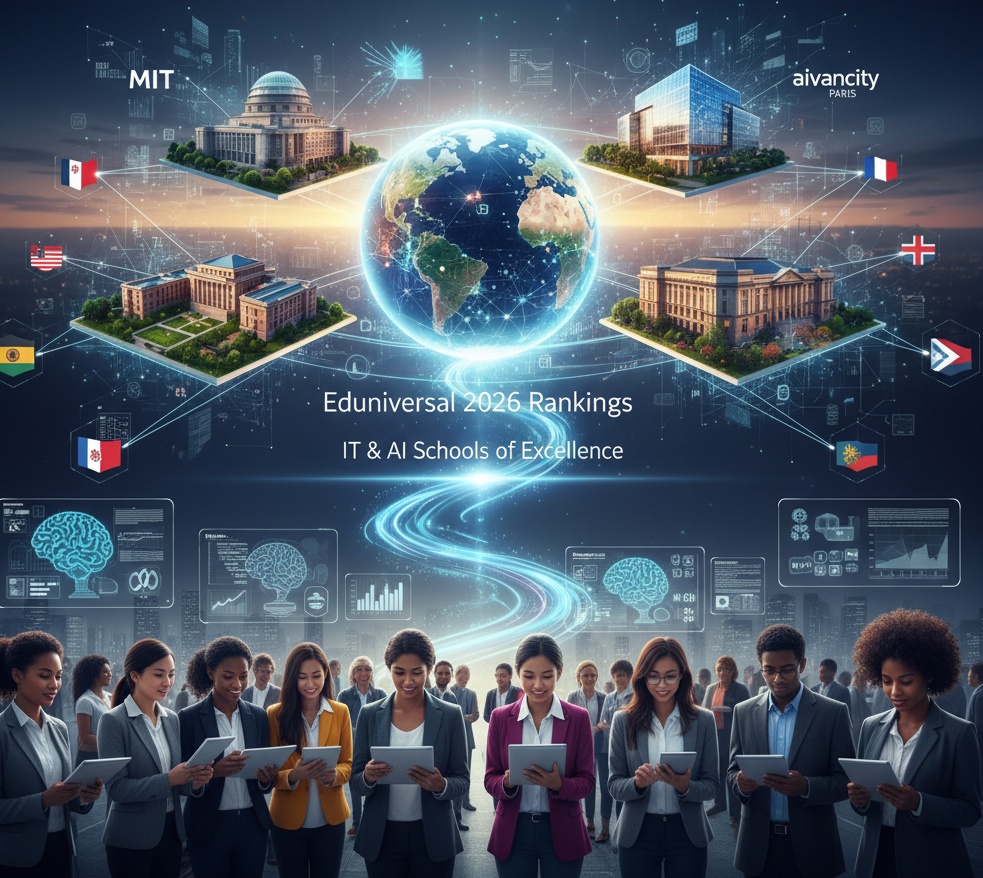
The race to train the next generation of AI engineers, data scientists, and digital architects is no longer a matter of national prestige — it is a question of global competitiveness. As artificial intelligence reshapes industries from healthcare to finance, from logistics to creative work, the institutions that prepare tomorrow's innovators have never carried more weight.
The Eduniversal 2026 Schools of Excellence in IT & AI ranking identifies the institutions that stand at the forefront of this transformation. Spanning 154 countries and regions, the Eduniversal methodology evaluates academic excellence, research impact, industry ties, and international influence to map the global landscape of technology education. This article explores the key trends, the standout institutions by region, and what it truly means to be a School of Excellence in the age of intelligent machines.
What Makes a School of Excellence in IT & AI?
Not all technology schools are created equal. Eduniversal's Schools of Excellence distinction goes beyond raw enrollment figures or historic prestige. The framework considers:
- Subdomains of expertise: Do programs cover the full spectrum — AI, Computer Science, Data Science, Cybersecurity, Robotics, Digital Transformation?
- Global influence level: From Regional actor to Emerging leader, National flagship, Continental leader, and International leader, each institution is positioned within a global hierarchy of impact.
- Palmes of Excellence: Eduniversal's signature recognition system, reflecting sustained quality assessed by academic peers worldwide.
- Innovation trajectory: Are institutions adapting their curricula to emerging technologies, or remaining anchored to outdated frameworks?
This holistic lens reveals a rich and geographically diverse picture of excellence — one that challenges the assumption that only a handful of Anglo-American universities define the world's best technology education.
The Global Geography of Tech & AI Excellence
North America: The Enduring Powerhouses
No map of AI education is complete without the cluster of International leaders that define the North American landscape. In the United States alone, Eduniversal identifies institutions in Canada and USA such as MIT, Stanford University, Carnegie Mellon University, UC Berkeley, and the University of Washington as holding the highest influence tier.
These are not institutions coasting on reputation. MIT's Computer Science and AI Laboratory (CSAIL) remains one of the most prolific AI research environments on the planet. Stanford's proximity to Silicon Valley ensures a constant feedback loop between academic research and real-world deployment. Carnegie Mellon's School of Computer Science pioneered foundational work in machine learning decades before the term entered mainstream vocabulary.
Canada contributes equally formidable entries: the University of Toronto, the University of Waterloo, and the University of British Columbia all carry International or Continental leader status.
Toronto, in particular, became synonymous with the deep learning revolution through the work of Geoffrey Hinton and his collaborators — a legacy that continues to shape the institution's AI research agenda.
Western Europe: Precision, Depth, and Emerging Challengers
Europe offers a striking diversity of excellence. At the apex sit the Swiss institutions: ETH Zurich and EPFL (École Polytechnique Fédérale de Lausanne) are both classified as International leaders, consistently ranked among the top five technical universities globally. Their combination of rigorous theoretical foundations with cutting-edge applied research makes them magnets for talent from every continent.
The United Kingdom maintains its historic stronghold: Oxford, Cambridge, Imperial College London, and UCL all hold International leader status. Germany contributes multiple International leaders as well — Technical University of Munich (TUM), RWTH Aachen, and Karlsruhe Institute of Technology (KIT) represent a tradition of applied engineering excellence that continues to evolve into the AI era.
France deserves particular attention for a different reason: it is producing a new generation of specialized Schools of Excellence designed specifically for the AI age. aivancity — La Grande École de l'Intelligence Artificielle & de la Data, founded in 2020, stands out as an Emerging global leader with 5 Palmes of Excellence.
Its dedicated focus on AI, Data Science, Cybersecurity, and Digital Transformation, with an explicitly professional and interdisciplinary approach, represents a new model of AI education — purpose-built rather than retrofitted.
École 89 – Deep Tech and Eigsi École d'ingénieurs complete France's trio of featured Schools of Excellence in IT & AI, demonstrating the country's strategic investment in specialized digital education alongside its traditional grandes écoles.
Scandinavia and Benelux add further depth: KTH Royal Institute of Technology in Sweden, TU Delft and Eindhoven University of Technology in the Netherlands, and the Technical University of Denmark (DTU) all carry International or Continental leader status, reflecting northern Europe's long-standing investment in engineering and applied sciences.
East Asia: The Rising Supercluster
Perhaps nowhere is the shift in the global balance of AI talent more visible than in East Asia. China alone contributes six institutions to the International leader tier: Tsinghua University, Peking University, Shanghai Jiao Tong University, Zhejiang University, Fudan University, and the newer ShanghaiTech University all appear in the Schools of Excellence pre-selection.
Japan's presence is equally compelling: The University of Tokyo, Kyoto University, Osaka University, Tohoku University, and the Tokyo Institute of Technology represent a national ecosystem of AI and computer science excellence with deep roots in robotics and human-computer interaction research.
South Korea rounds out the East Asian powerhouse with KAIST (Korea Advanced Institute of Science and Technology) and Seoul National University holding International leader classifications. POSTECH and the broader KAIST engineering schools reinforce South Korea's strategic positioning at the cutting edge of semiconductor and AI research.
Singapore stands as a microcosm of global ambition: both NUS (National University of Singapore) and NTU (Nanyang Technological University) are International leaders in the IT & AI domain — a remarkable achievement for a city-state of under six million people, and a testament to the power of deliberate national investment in research excellence.
South and Central Asia: India's Institutional Strength
India's contribution to global AI talent is well documented in industry — but it begins in academia. The Indian Institute of Science (IISc Bangalore), IIT Bombay, and IIT Delhi are recognized as Continental leaders in IT & AI, reflecting India's deep tradition of mathematical and computational excellence. With a large and growing cohort of AI researchers, and active partnerships with global technology firms, these institutions are poised to expand their global influence in the years ahead.
Nazarbayev University in Kazakhstan and the Tashkent University of Information Technologies in Uzbekistan signal a broader Central Asian emergence in the digital education space, classified as Emerging leader and Regional actor respectively.
Latin America and Africa: Building Regional Champions
The Schools of Excellence ranking takes seriously the global breadth of technology education. In Latin America, University of São Paulo, University of Campinas (UNICAMP), and Federal University of Rio de Janeiro (COPPE/UFRJ) in Brazil, alongside University of Buenos Aires in Argentina, anchor a regional ecosystem of serious academic AI research.
Africa's representation — led by University of Cape Town, University of the Witwatersrand, University of Nairobi, University of Lagos, and Cairo University — reflects both the current landscape and a trajectory of growth. As digital transformation accelerates across African economies, these institutions serve as critical nodes of technical capacity building.
The Middle East contributes rising stars: KAUST (King Abdullah University of Science and Technology) in Saudi Arabia, Technion and Hebrew University of Jerusalem in Israel, Qatar Computing Research Institute (QCRI), and Khalifa University in the UAE all appear — each an Emerging or Continental leader building research environments at the intersection of AI and regional development priorities.
What the 2026 Rankings Reveal: Five Key Trends
1. Specialization is gaining ground over breadth. The emergence of institutions like aivancity and École 89 – Deep Tech signals a growing market for schools entirely devoted to AI and emerging technologies, rather than offering AI as one department among many.
2. Asia is not "catching up" — it has arrived. With more than 20 institutions across China, Japan, South Korea, Singapore, and India holding International or Continental leader status, the center of gravity of global AI research is genuinely multipolar.
3. Cybersecurity is the new frontier of differentiation. As virtually every institution covers AI, Computer Science, and Data Science, the ability to integrate Cybersecurity expertise has become a key differentiator. Institutions from UCL to Technion to NUS list it prominently.
4. Emerging leaders are geographically diverse. ShanghaiTech (2013), KAUST (2009), Khalifa University (2007), and Nazarbayev University (2010) are all relatively young institutions already holding international recognition — demonstrating that strategic investment can rapidly build world-class programs.
5. Digital Transformation is an explicit curriculum priority. Beyond technical skills, leading institutions increasingly teach the organizational, ethical, and strategic dimensions of digital transformation — preparing graduates not just to build AI systems but to deploy them responsibly.
How to Use the Eduniversal Schools of Excellence Ranking ?
For prospective students, the ranking offers a globally calibrated guide to institutions where AI and technology education has been rigorously validated by an international academic community. Whether you are looking for a specialized AI school in Paris, a research powerhouse in Zurich, or a rapidly rising program in Singapore or Seoul, the pre-selection provides a shortlist grounded in genuine peer evaluation.
For employers and recruiters, the Schools of Excellence designation signals graduates who have been trained in environments committed to research depth, curriculum relevance, and international standards — not just technical skills but the capacity to navigate complex technological challenges.
For institutions themselves, inclusion in the Eduniversal pre-selection is a recognition that carries weight: it connects schools to an international network of academic leaders, opens doors to global surveys and benchmarking, and positions them within the world's most comprehensive cross-regional education ranking.
Latest news

07/10/2026
In a world where design has become a strategic lever at the heart of organisations, L'École de Design Nantes Atlantique stands as one of Europe's leading references in design education.

07/06/2026
In the global landscape of management education, MIRBIS, the Moscow International Higher School of Business, occupies a category of its own. Awarded 5 Palmes of Excellence by Eduniversal, accredited by AMBA, and home to a community of 34,000+ alumni

06/30/2026
Discover Bologna Business School, where centuries of academic excellence meet modern business education built for the leaders of tomorrow.